Project [07] 🐶 Pet Manager Exploring Classes & OOP
📘 Introduction
Welcome to Pet Manager, a Python project where you’ll design and build a fast-paced animal care simulation while learning one of the most important programming skills: Object-Oriented Programming (OOP).
In this project, you won’t just use classes—you’ll design them, extend them, and connect them together to form a complete program. By the end, you’ll have a working terminal-based game where players care for animals, level them up, and unlock new pets… all powered by your own code.
This project is designed to move quickly. The goal isn’t to play a game for a long time—it’s to build one intelligently.
💻 What Is This Project About?
In Pet Manager, you will create a Python program that simulates taking care of virtual animals.
Your program will:
- Represent animals using classes
- Store animal data such as hunger, happiness, cleanliness, and level
- Allow the player to feed, play with, and clean animals
- Use inheritance so different animals behave differently
- Track experience points (XP) and leveling
- Unlock new animals as the player levels up
- Run inside a terminal-based game loop
The program is structured like real software:
- A base class that defines shared behavior
- Subclasses that customize behavior
- A player class that manages multiple animals
- Helper functions that control user input and game flow
This mirrors how object-oriented programs are written in real applications and games.
🧠 What You’ll Learn (Coding & Python Topics)
By completing this project, you will practice and apply:
- Creating and using classes
- Writing
__init__constructors - Using instance variables
- Applying encapsulation (protecting internal data)
- Creating getter properties with
@property - Using inheritance to extend a base class
- Overriding methods in subclasses
- Using polymorphism with shared method names
- Working with lists of objects
- Storing classes in dictionaries
- Writing and calling instance methods
- Designing a simple game loop
- Handling user input safely
- Structuring a large Python file logically
These are core OOP skills that transfer directly to advanced Python, Java, C++, game development, and software engineering.
🎯 Learning Objectives
By the end of this project, you will be able to:
- Design a base class that models shared behavior
- Create subclasses that modify and extend that behavior
- Explain the difference between a class and an object
- Use composition to manage multiple objects inside another class
- Read and write object-oriented Python code confidently
- Build a complete, multi-class Python program from scratch
- Understand how OOP helps manage complexity in larger programs
🧭 How to Navigate This Document
Before we dive into coding your very first Python mystery game, here's how to move around this digital guide:
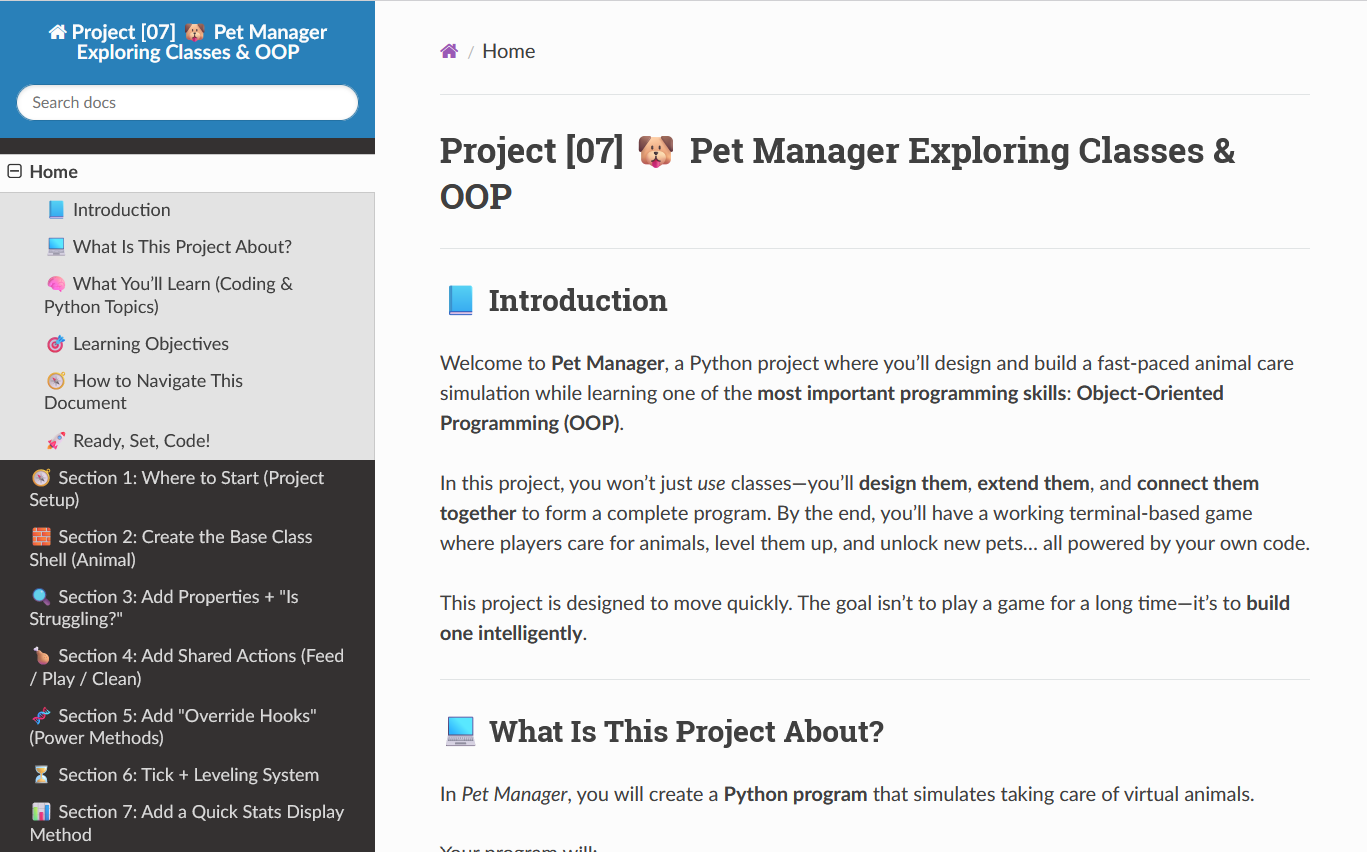
🔽 Use the Section Dropdown at the Top Right
At the top right of this document, there’s a dropdown menu. Click it to quickly jump to any section of the project—from Section 1 all the way to the final run.
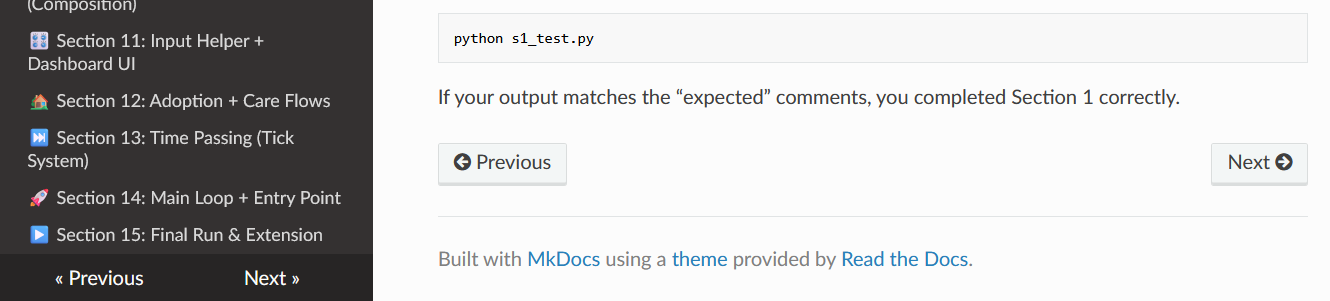
🔽 Jump to the Next Section Using the Bottom Menu
If you scroll all the way to the bottom of the page, then move your mouse down to the very bottom, a small bar will pop up that lets you go to the next section.
🔙 To Go Back, Use the Dropdown Again
There is no back button, so to return to a previous section, you’ll need to click the dropdown menu in the top right again and choose the earlier section.
🛠 Tip: Work One Section at a Time!_
Each section gives you a bit of code and teaches a new idea. Don’t rush! After each section, test your work with the small test file provided.
🚀 Ready, Set, Code!
This project is broken into clear, manageable sections.
Each section builds directly on the last, and by the end, you’ll have a fully working program that you created step by step.
Don’t rush. Don’t copy blindly.
Focus on why each class exists and how the objects interact.
When you’re ready, jump into Section 1 and start building your first pieces of the Pet Manager system. 🐾💻